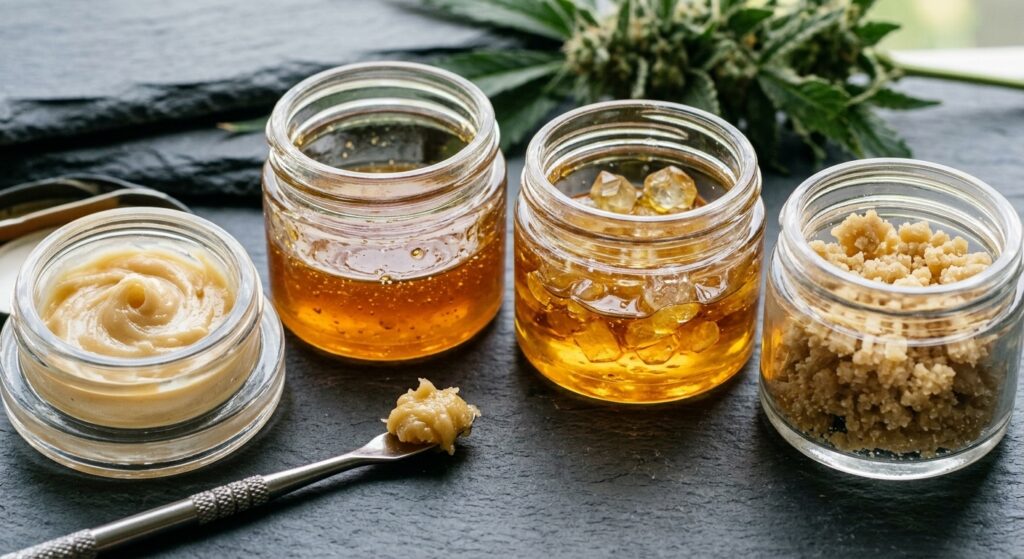
Badder. Budder. Sauce, sugar, diamonds, shatter. Those are the words at the end of a concentrate name on our menu, and every one of them describes consistency rather than strength.
A concentrate gets its texture from what happens after the cannabinoids and terpenes come off the plant. Two jars can start as the same batch of extract, get finished two different ways, and land on the shelf under two different names at two different prices. Nothing about the plant changed. What changed was heat, time, and whether anyone stirred it.
What a Texture Name Tells You
Texture describes the physical state of the finished extract. That is the whole job of the word. It says nothing about the starting material, the extraction method, or the potency, because those sit elsewhere in the product name.
Concentrate names run long for a reason. Every part is doing a separate job, and once you can split them apart the case gets much easier to shop.
Take one jar off the shelf: Aeriz Jenny Kush Live Budder 1g. Aeriz is the brand. Jenny Kush is the strain, a hybrid bred by Rare Dankness Seeds and named for the cannabis activist Jenny Monson. Live means the plant went into extraction fresh frozen instead of dried and cured. Budder is the texture. One gram is what is in the jar. Beta caryophyllene, myrcene, and limonene lead its terpene profile.
Notice what that name does not tell you: how the extract came off the plant. Solventless products almost always say so, printing rosin or solventless right in the name, so a jar reading only live budder or live badder came out of a solvent process. Texture and extraction method are independent of each other. A badder can be solvent based or solventless, live or cured, and still be a badder.
Where Texture Gets Decided
Solvent based extraction leaves you with a soup of cannabinoids, terpenes, and residual butane or propane. That solvent has to come out, and the step that removes it is called the purge: the extract goes into a vacuum oven, where dropping the pressure lowers the temperature at which the solvent boils, so it can be pulled off without cooking away the aromatic compounds. Every texture in the case is a different answer to how that purge was run.
Leave the extract undisturbed at low heat for a long purge and the material sets into an even, glassy sheet. That is shatter. Whip it while it purges and the agitation works air through it, breaks up the molecular arrangement, and stops the cannabinoids from locking into crystals. That is badder. Run the heat higher or hold it longer and more moisture and terpene content leaves, giving a dry, breakable finish. That is crumble. Leave it alone entirely, under its own pressure, for weeks instead of hours, and it separates into two things: solid crystals sitting in a pool of liquid.
The starting material puts a ceiling on all of it. Fresh frozen plant material carries far more terpene content into the extract than dried and cured material does, and terpene rich extracts stay wetter and softer no matter how they are handled. That is why the word live shows up constantly on soft textures and almost never on shatter. An extractor working with a low terpene input is going to have a hard time producing a lush, saucy jar, and one working with a heavy terpene load is going to have a hard time producing a stable glass sheet.
Rosin skips this whole conversation, since there is no solvent to remove. Its texture comes from the cure instead. Pressed rosin taken straight off the plates is loose and often runny, called a fresh press. Held at a controlled low temperature for days, the same material tightens into the creamy, scoopable state sold as a rosin badder. Held differently again, it stays wet and spoonable and gets sold as jam.
Badder, Budder, and Batter
Badder is whipped. The agitation works air in and interrupts crystal formation, and what comes out is opaque, soft, and spreadable, closer to frosting than to anything glassy.
Because the cannabinoids stay suspended instead of separating out, the terpene fraction stays distributed through the whole jar rather than pooling at the bottom. Your first scoop and your last scoop are the same material. That is the trade whipping makes, and it is the reason this texture is the most common thing on any concentrate menu.
Badder, budder, and batter are the same production idea with different spellings, and the usage is not standardized. Some jars read Live Badder, some read Live Budder, one brand calls its version Budder Wax. Where producers do draw a line, badder tends to be the wetter and softer of the two and budder the more aerated, but the word on the label follows brand convention more than any industry rule. If the distinction matters to you, look at the photo rather than the noun.
One thing worth knowing before you buy: badder is not a permanent state. The material was whipped out of its natural tendency to crystallize, and given enough time, warmth, or jostling, some of it drifts back. A jar that was smooth in March can be grainy in July. That is chemistry doing what it does, not a defect.
The Jenny Kush jar above is the solvent side of this texture. FloraCal Farms Purple Plague Live Rosin Badder 1g is the other side, a sativa dominant rosin pressed from ice water hash with no solvent involved, cured to the same scoopable consistency. It comes through gassy and chemical, a terpene profile that survived a freeze and a press rather than a purge.
Sauce, and the Jam Sitting Next to It
An extract coming out of a hydrocarbon run is supersaturated with THCA, which means it holds more of the compound in solution than it can keep there. Given time and gentle pressure, usually one to three weeks in a sealed jar under mild heat, the excess falls out of solution and hardens into crystals. Extractors call that step diamond mining. What is left surrounding those crystals is the fraction that did not crystallize: a thick, glossy, terpene heavy liquid the industry labels high terpene extract, and the menu labels sauce.
So sauce and diamonds are not two products that were combined. They are one product that came apart.
Sauce gets sold on its own, and it gets sold in the same jar as the crystals it separated from. It is wet, it moves, and it will run off a flat dab tool. It also carries the highest terpene load of anything in the case, which is the entire argument for buying it.
Beezle SFV OG Live Sauce 2g is the sauce on the menu at the moment, a two gram jar that runs pine, fruit, and earth. SFV OG is a clone only cut out of the San Fernando Valley and a descendant of OG Kush.
Sauce is the format most likely to be missing from the case on any given visit, so it is worth asking about rather than assuming.
Diamonds, in a Jar and in a Pre-Roll
Diamonds are the crystals from that separation. Left to grow, they build into structures that look like rock candy or cut glass, and the longer they sit, the larger the individual stones get. A well grown stone is close to pure THCA and carries almost no terpene content, which is exactly why it usually shares a jar with the sauce it came out of. The crystals bring the cannabinoid load. The liquid brings the flavor.
Raw THCA is not intoxicating. Heat converts it, a reaction called decarboxylation, which is why the crystals do nothing sitting in the jar and everything on a hot surface.
On our menu, diamonds show up in a place that is easy to miss, which is inside pre-rolls rather than inside a jar. Rythm Remix Watermelon Z Diamond Infused 1g Pre-Roll is an indica dominant joint with the crystal fraction worked into it, sold as a single gram and in a 2.5g five pack. No rig, no dab tool, and the same source material that fills a diamonds jar.
Liquid diamonds, the term printed on some other infused products, means those same crystals melted back into a terpene rich liquid so they can be applied to a joint or filled into a vape. The name describes a state, not a grade.
Picking Between the Three
All three can come out of one extraction run, so the choice between them is not a choice about strength. It is a choice about what you want the material to do in your hand.
Badder gives you the least fuss: it holds its shape at room temperature, scoops off the tool without stringing or sliding, and portions the same way every time. Terpenes stay distributed through the jar, so the last dab matches the first. The trade is that it drifts toward graininess as it ages, and it is the texture most exposed to air, so flavor fades sooner than it does in a sealed sheet of shatter.
Sauce gives you aroma: it carries the heaviest terpene load of anything in the case, because it is the fraction where those compounds concentrated when the crystals dropped out. That is the whole argument for it. The trade is handling. It runs, it needs a cupped tool and a sealed jar, it is the most sensitive to warmth, and it punishes a hot banger faster than any other texture.
Diamonds give you density: the crystals are close to a single isolated compound, so a small piece goes a long way and stones store better than any soft texture, since there is less surface area for air to work on. The trade is flavor, which is why the crystals are usually sold sitting in sauce rather than alone, and patience, since a solid stone melts slower than a scoop of anything else.
Put plainly: badder for handling, sauce for aroma, diamonds for density. Where the crystals and the liquid share a jar, you are buying both sides of that separation at once.
Sugar, Crumble, Shatter, and Hash
Four more names in the same case, each one a different point on the same spectrum.
Sugar is a crystallization caught partway. The THCA started coming out of solution but nobody grew it into stones, so it stays granular and damp, like wet sand. It handles somewhere between sauce and badder, and it portions cleanly.
Crumble is what a longer or warmer purge produces. Dry, matte, breaks apart under the tool.
Shatter is badder’s opposite, purged with no agitation at all so the material sets into a hard translucent sheet. Worth knowing: shatter also drifts toward crystallization over time. When it does, it clouds and softens, which shops call sugaring up. Same process that turns a badder grainy, showing up on a different texture.
Hash does not follow this naming logic at all, because it was never dissolved into anything. Bubble hash, piatella, and pressed hash describe how trichomes were separated from the plant with ice, water, and screens, rather than how an extract was finished.
What Texture Cannot Tell You
Potency is the big one. Two jars finished differently out of the same extraction run carry similar cannabinoid content, so a badder is not weaker than a shatter by virtue of being soft, and the crystals in a diamond jar test high because they are one isolated compound rather than because the batch was better. The panel on the menu is the only place that answers this, and it moves batch to batch.
Texture also cannot tell you quality. A carefully made crumble beats a carelessly made live badder. What it does predict, reliably, is how the product behaves in your hand and on your device, which is a smaller claim and a more useful one.
Handling, Tools, and Storage
Texture decides the tool.
A flat or spoon shaped dab tool handles badder, budder, sugar, and crumble without any technique, since all four hold their shape at room temperature. Sauce needs a cupped or paddle end and it belongs in a jar rather than on parchment paper, because it will migrate. Diamonds get placed rather than scooped.
On the device side, the banger is the heated cup on a dab rig, and a carb cap sits over it to hold vapor and heat in place. Softer, wetter, terpene heavy material rewards a cooler banger, since those aromatic compounds are the first thing to burn off. A large diamond needs more patience instead of more heat, because a solid stone has less surface area than a spread of badder and takes longer to liquefy at the same temperature. Turning the heat up to rush it is what scorches the sauce around it. For sauce specifically, a cold start, where the material goes into a cool banger that gets heated afterward, keeps more of the aroma intact.
Portable concentrate pens with a coil or ceramic chamber handle badder and sugar well. Sauce works in the same devices but loads messier and can leak past the chamber.
Storage runs the same across all of them: cool, dark, sealed, out of sunlight. Wetter textures are more sensitive to warmth than a stone or a sheet of shatter. If a jar has been in the refrigerator, let it reach room temperature before opening, so moisture in the air does not condense inside the container when you break the seal.
Frequently Asked Questions
Why did my badder turn grainy in the jar?
It crystallized. Cannabinoids in a whipped extract sit in an unstable state, and over time, especially with warmth or agitation, some of them start forming the same structures that make diamonds. The material is still the material. It scoops differently.
Can badder go in a dab pen?
Yes, in a pen built for concentrates with a coil or ceramic chamber. Sauce works in the same devices but is far messier to load.
Is live resin badder the same thing as live rosin badder?
No. Both were whipped or cured to the same consistency and both started from fresh frozen plant material. Only the extraction differs, hydrocarbon for resin and heat plus pressure for rosin.
What does the gram weight after the strain refer to?
Net weight of concentrate in the container. Nothing else.
Why does the same brand sell badder and shatter of the same strain at different prices?
Time and yield, mostly. Textures that require a longer hold, a controlled cure, or weeks of separation tie up equipment and lose material along the way, and solventless work costs more before anyone even picks a texture, since it takes more plant material to produce a gram.
How long does a concentrate keep?
Longer than most people plan for, if it is sealed and cold, and the failure mode is usually flavor rather than potency, since terpenes are the lighter and more volatile compounds and they leave first. Textures that were whipped have more surface area exposed to air than a sheet of shatter does, which is why storage habits show up faster in a badder jar.
Shopping Concentrates at Ivy Hall
Texture is the fastest filter in the concentrate case and the one that tells you the least about what is in the jar. Start there anyway, because it decides whether the product suits your tools and your patience. Then read the rest of the name: the brand, the strain, whether it says live or cured, whether it says resin or rosin. The lab panel for the exact jar you are holding is on the menu, since results move batch to batch.