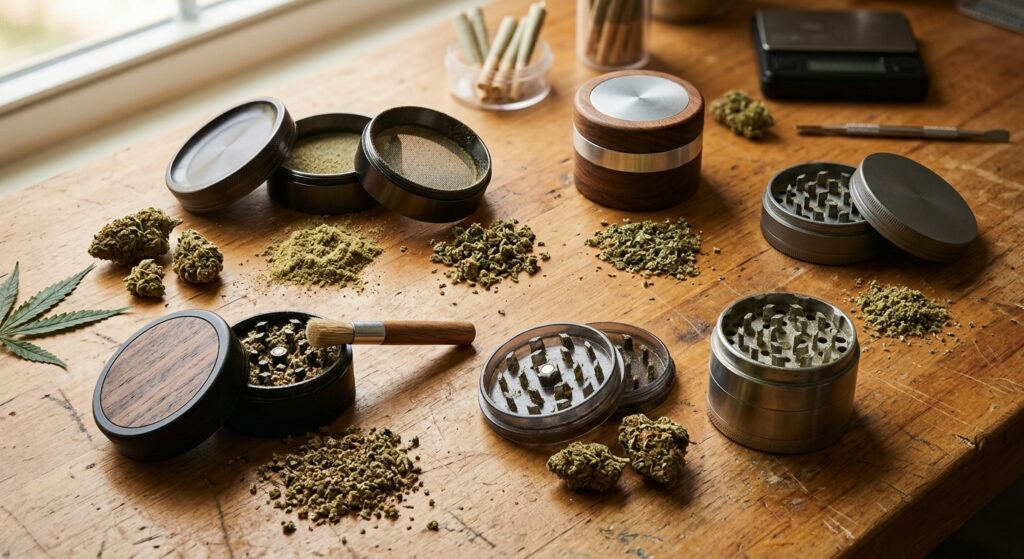
The grinder you should buy is decided by how you consume, not by which one looks best in the case. Roll joints and you want a medium texture and a wide chamber to work out of. Pack a bowl or a bong and you want coarser, because airflow matters more than surface area. Use a dry herb vape and you want the finest grind you can get. Share with a group and capacity outranks everything else.
Everything below explains what each choice costs you, so you can work backward from the one that fits.
What a Kief Screen Costs You
Piece count decides where the trichome powder ends up, which matters more than how many parts you are getting for the money.
A four-piece has a mesh screen between the flower chamber and the bottom. The fine powder that breaks off the buds falls through that screen and collects underneath, which means it is out of the flower you scoop into your bowl. You are banking it. Over weeks it builds into enough to top a bowl or add to a joint, and you get a second thing out of the same eighth.
A three-piece has no screen. Everything that comes off the bud stays mixed in with the flower, so what you scoop is what the plant gave you. Nothing is diverted, nothing is waiting for you in a chamber you forgot about.
That is the trade, and it cuts cleanly by volume. Heavy flower buyers fill a kief chamber fast enough for the screen to pay off. Someone going through an eighth a month may wait months for a usable amount, and would rather have that powder in the bowl now. Fewer parts also means less to clean and one less thing to lose.
Two-piece grinders skip both. A lid, a base, no chamber at all, so the flower stays with the teeth until you tip it out, and it keeps getting finer every turn you take. They work if you grind straight onto a tray and go.
Storage rides along with this decision. Whichever chamber holds your ground flower between sessions is the one that has to seal, because ground flower dries out and carries more smell than a whole nug does.
Threads or Magnets Decides How It Feels in Month Six
Most people buy a grinder without checking how the lid attaches, then fight with it six months later.
A threaded grinder screws together. Resin works its way into the thread grooves every time you turn it, and it builds. The twist gets stiffer, then sticky, then you are soaking the thing in alcohol to get it back. Grooves are almost impossible to brush clean, which is why threaded grinders get retired long before their teeth wear out.
A magnetic lid has nothing to fill. It lifts straight off, seats flat, and opens one-handed while you are holding a bowl in the other. Our Mill Grinder Blackwood by Vessel is built that way: a three-piece with a magnetic lid, an aluminum body with a wood inlay, 55.5mm across and 62g in the hand, carrying a one year limited warranty. It also comes with a walnut inlay if the darker blackwood is not your taste.
If you are deciding between two grinders at the same size and material, the lid is the tiebreaker.
Material Decides Lifespan More Than It Decides Grind
Aluminum and stainless both grind flower fine on day one. What separates them shows up over years.
Aluminum is a soft metal. Teeth dull gradually, threads and edges take the wear, and a drop onto tile can dent a lip enough to throw off how the halves sit. Anodized aluminum pushes that timeline out a long way and stays light enough to carry, which is why it is the standard.
Stainless steel is harder on every count. It holds an edge, shrugs off drops, and outlives most of the things you will smoke out of. You pay two ways: it is more expensive to machine, and it is noticeably heavier in a pocket.
Wood belongs to a different question entirely. It looks and feels better than an aluminum puck and it never gets cleaned the same way, since wood should not soak. A wood inlay set into an aluminum body splits the difference, which is what the Mill is doing.
Plastic and acrylic teeth snap. And if a grinder is unbranded with unidentified metal, pass on it, because soft mystery alloys can shed flakes into what you are about to smoke.
Grind Texture Belongs to Your Device
Grind texture should follow what you are loading it into rather than what you assume you prefer.
Dry herb vapes want fine and fluffy. The oven heats by contact and airflow, so more surface area means faster, fuller vaporization out of less flower. This is the one case where grinding finer has a clear payoff, up to the point where you pack it so tight the air cannot move.
Bowls, bongs, and pipes do better a little coarser. A fine grind packs dense, chokes the airflow, and pulls through the hole into your mouth. Coarser burns slower and pulls easier.
Joints and cones sit in the middle. Fine enough to pack evenly with no stems poking the paper, coarse enough that the roll still draws.
Most grinders land at medium out of the box, and you can push finer by taking a few extra turns. Going coarser is harder, which is worth knowing if you smoke mostly glass.
Width Should Match How Much You Buy at a Time
Grinder diameter maps to how often you stop and empty it, so match it to your usual purchase rather than to the biggest one available.
Under 2 inches is a pocket grinder. Buy an eighth at a time and it is enough, though you will reload for anything past a bowl or two, and small bodies are harder to grip with sticky fingers.
Around 2.2 to 2.5 inches handles most people’s week without reloading. Our Grinder 2.5″ Assorted Colors sits at the top of that range, and the Mill runs more compact at 55.5mm.
Past 2.5 inches you are buying for batch work: a quarter or more broken down in one sitting, or a grinder that gets passed around. Our 63mm 4pc Caved Top Grinder Assorted Colors is the four-piece in that range, with the screen and kief chamber underneath.
A wider lid gives your hand more to hold onto, which is the quiet reason bigger grinders feel easier to turn even when they are full.
What You Are Choosing Between at a Counter
Dispensary accessory cases carry working grinders rather than boutique machined pieces, and the honest version is that the variables above are where the differences live. Piece count, how the lid attaches, what it is made of, how wide it is. Those four decide whether you like the thing in a year.
Teeth design and grind plates are the axis boutique grinders compete on, with swappable plates and toothless mills that break flower against friction surfaces instead of cutting it. Worth knowing the category exists. It is not the choice in front of you at a counter, and it is not the one that decides whether a grinder still turns smoothly next spring.
Frequently Asked Questions
How many pieces should a first grinder have?
Four, if you buy flower regularly. The screen and the bottom chamber cost little over a three-piece and you grow into them. Buy light and the three-piece is the better call.
Do you need a grinder for a dry herb vape?
More than for anything else. Whole nugs will not fit most ovens, and the parts that do sit against the chamber wall while the middle stays raw. Ground flower packs flat, heats through, and pulls easier.
Does a grinder work for pre-rolls?
No need. Pre-rolls arrive ground and packed. A grinder earns its place with whole flower.
Can you use a coffee grinder on cannabis?
Bad idea on both ends. Blade grinders pulverize flower into dust that clogs airflow and burns too fast, and the resin coats the blades and transfers into whatever you grind next.
How do you clean a grinder?
Cleaning method follows the material. All-metal grinders take a soak in isopropyl alcohol, then a rinse and a full dry. Wood should never soak, inlay included; brush it out dry instead. A stiff brush and a toothpick handle most buildup on any material, and a grinder brushed out every few weeks rarely needs the soak.
Why does my grinder get harder to turn?
Resin in the threads.
What does a caved top do?
The caved top is a lid shape rather than a mechanism, and it is there for your palm. The dish gives your hand a surface to press into on the first few turns, which is when a dense nug is still fighting back.
What size grinder fits in a pocket?
Under 2 inches, comfortably. A 2.5 inch grinder rides better in a bag than in jeans.
Getting a Long Life Out of the One You Buy
A grinder that gets a little attention lasts years longer than one that does not. Brush the teeth out when the grind starts feeling sticky rather than waiting for it to seize. Tap the screen from the side to move kief through instead of pushing down on it, which stretches the mesh. Store it closed and dry.
One more habit worth building: grind what you plan to use in the next few days, not your whole jar. Flower holds its aroma better whole, and the terpenes that carry the smell of a strain are the first thing to go once it has been broken up and left sitting.