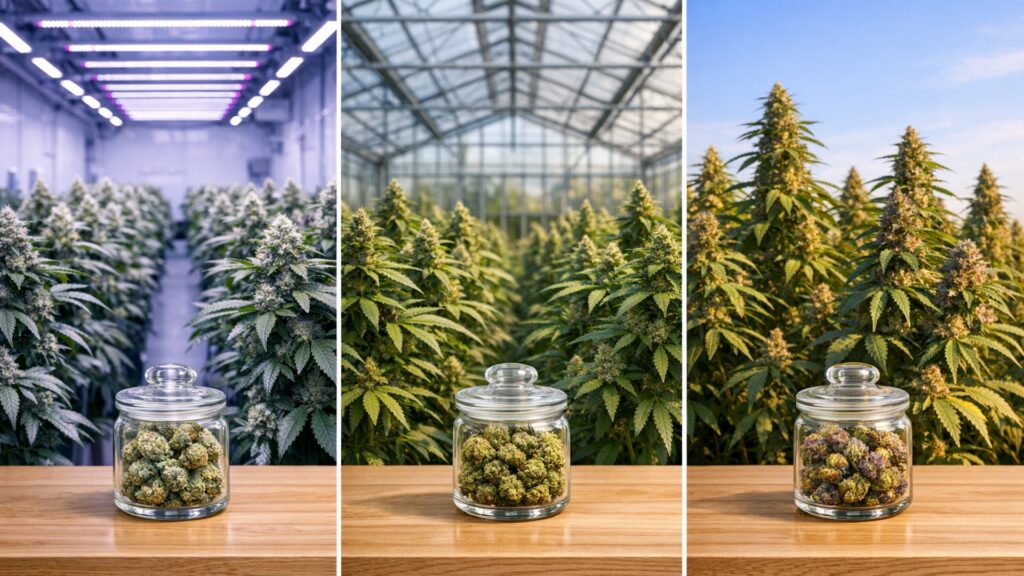
You bought a strain you liked. Weeks later you bought it again, same name on the label, and the jar smelled like a cousin of the first one rather than a twin. Looser buds, maybe. A different color running through them, or an aroma that leaned somewhere else entirely.
Nothing went wrong. Indoor, greenhouse and sun-grown are the three terms the conversation usually turns to here, and they get treated as a quality ranking: indoor at the top, greenhouse in the middle, sun-grown at the bottom. That ranking is not what the words mean. They describe where a plant got its light and how much of its environment the grower controlled, which is a question about method rather than merit.
A strain name works the same way. It describes genetics, and genetics set a range rather than a fixed outcome. Where a jar lands inside that range comes down to who grew the plant, how they grew it, when they cut it, and what happened to the flower between the drying room and the shelf. Here is what the three terms cover, and then how to read the rest of it at the counter.
What Indoor, Greenhouse and Sun-Grown Mean
Each term answers the same question: where did the light come from, and who decided the weather?
Indoor: the plant grows entirely under artificial light in a sealed, climate-controlled room. The grower sets light intensity and spectrum, hours of light, temperature, humidity, airflow and carbon dioxide, and nothing is left to the season. Harvests run year round because the room, rather than the calendar, decides when a plant flowers.
Greenhouse: also called mixed light, this is a structure where daylight does most of the work while supplemental lamps, shades, vents and heating fill the gaps. It sits between the other two. Growers get much of the sun for free and keep some ability to steer the environment, including the option to shorten the perceived day with blackout systems and bring a crop in outside the usual schedule. The flower tends to land between the other two in appearance, tidier than open-field buds without the uniformity of a sealed room.
Sun-grown: usually meaning outdoor, where plants grow in open air under natural sunlight, in natural soil or beds, on a seasonal schedule. In most climates that means one harvest in the fall. It is the oldest and lowest-energy way to grow cannabis, and the most exposed to weather.
That exposure shows up in the jar. Outdoor plants are not boxed in by ceiling height, so they grow larger overall, and their buds often come out airier and less uniform than flower from a room where light and airflow were managed around every branch. Wind, rain and real temperature swings leave their mark too, including wider color variation across greens, golds and purples in cultivars that carry it. Looser structure reads as lower quality to a lot of shoppers. What it reflects is a plant that grew in weather.
The trade-off runs in one direction. More control costs more energy and money. Less control means the grower works with whatever the season hands them, and leans harder on matching the right genetics to the right place.
Why Flower in the Chicago Area Is Grown Indoors
Flower sold in Illinois dispensaries is grown inside. State rules tie licensed cultivation to an enclosed, locked facility, so the plants behind the jars on our shelves at Ivy Hall spent their lives under lights in a room somebody built on purpose.
That shapes what is worth paying attention to here. The sun versus lamp debate that fills national cannabis writing is a question about other states’ shelves, and it does little for a shopper standing in front of an Illinois menu. What matters locally is everything that still varies between two indoor jars, and plenty does.
Indoor control is also doing real work for you. A cultivator who has dialed in a room can repeat it, which is why a brand you trust tends to deliver something recognizable each time you buy it. Flower arrives here fresh all year rather than once a season. And the plants grow with no rain landing on the buds, no windblown dust and less exposure to outdoor pests.
What a Grower Controls Once the Doors Close
A grow room is a long list of decisions, and the plant answers each one in a way you can see or smell later. A few of the connections are direct enough to name.
Light intensity and how close the canopy sits to it influence resin development, which is why flower from a tightly managed room often carries heavier visible frost. Plant spacing and pruning decide how much light and air reach the lower branches, and that is most of the reason buds further down a plant finish smaller than the colas at the top. Temperature matters twice over: swings between day and night bring out purple and red tones in cultivars that carry the genetics for them, and sustained heat late in flowering costs aroma. Humidity has to come down through flowering to keep dense buds healthy, and how a grower handles that often decides when they cut. Harvest timing then sets maturity, and maturity shifts both the cannabinoid content and the aromatic profile of the finished flower.
Move any of those and the jar changes. Tighter or looser structure. More resin or less. An aroma that comes through sharp and citrus-forward from one room and heavier and sweeter from another, out of identical genetics.
Those decisions go deeper than the lights, down to what the roots sit in. Soil, coco coir and water-based systems each feed a plant differently, and growers pick among them for reasons that show up in the jar.
Aeriz Jenny Kush 3.5g is the clearest example on our menu, because Aeriz grows aeroponically. No traditional soil at all. The roots sit in reusable clay pebbles and take water and nutrients directly, which gives the grower precise control over what reaches the plant and when. Hold that jar next to a soil-grown hybrid and you are holding two different answers to the question of how to feed a cannabis plant.
Two cultivators running the same genetics in two different rooms are making two different sets of decisions. Both jars are honest versions of that strain.
Terpenes Are What You Are Smelling
Aroma in cannabis comes mostly from terpenes, a family of aromatic compounds the plant produces in its resin glands. They are the reason one jar smells like lemon peel and the next smells like diesel or pine, and they are what people are reaching for when they say a strain smells loud.
A handful come up often enough to recognize by name. Limonene reads as citrus, bright and sharp. Myrcene is earthy and musky, with a herbal edge. Beta-caryophyllene comes through peppery and spicy. Pinene smells like pine and fresh-cut wood. Linalool is floral, in the direction of lavender. Humulene leans woody and hoppy. Most flower carries several at once, and the balance between them is what makes an aroma specific rather than generic.
Here is why that matters for two jars of one strain. A cultivar can only produce the terpenes its genetics allow, but how much of each it produces depends on growing conditions and how mature the plant was when it came down. Then comes the part that undoes growers: terpenes are volatile, so a share of them leaves during drying, curing, packaging and storage. The profile listed on a product page belongs to that batch and that batch alone. Two runs of the same cultivar can land in noticeably different places.
What to Look For Through the Glass
Most of what a shopper can judge about flower happens by eye, through a jar or a display case, and a few things are worth more attention than others.
Trichomes: the resin glands on the surface of the bud, which look like a coating of frost. Cannabinoids and aromatic compounds concentrate in them, so coverage is worth noticing. It is not a measurement of anything, and the tested figure for that batch is on the product page.
Bud density: how tightly the flower is packed. This tracks the cultivar and the growing conditions more than the grower’s skill, and dense does not mean better. Some well-regarded cultivars finish airy by nature.
Pistils: the fine hair-like strands running through the bud. They shift from pale to deeper orange and amber as a plant matures, so they offer a rough read on how far along the flower was at harvest.
Trim: how cleanly the leaf was cut away. Hand-trimmed flower keeps more of its resin intact than machine-trimmed flower, and heavy leftover leaf is worth noticing in a jar you are paying a premium for.
Color: greens through to purple, depending on genetics and the temperatures the plant saw. Purple looks striking and tells you little else.
Feel, if you get to handle it: flower should have a slight give and spring back. Crumbling to dust means it dried out. Damp or spongy means too much moisture stayed in.
Bud Size Is a Grade, Not a Verdict
Here is where shoppers talk themselves out of good flower. Popcorn buds are the smaller ones that grow lower on the plant, beneath the large colas at the top, and they get sorted into their own grade after harvest. Same plant. Same harvest. Same genetics and the same cure as the full-size buds from that run.
Our menu lets you see this directly. Ozone Butterstuff 3.5g is the full-size grade of that indica, and Ozone Butterstuff Popcorn 7g is the smaller-bud grade of the same strain from the same cultivator. What differs between them is bud size and how much flower is in the bag. Buying in volume is where popcorn tends to make sense, since you get more in one purchase without changing which plant it came from.
Big nugs photograph better. That is most of what they are telling you.
Genetics Set the Ceiling Before Anyone Touches It
No room makes a plant do something its genetics cannot. A cultivator optimizes conditions around a cultivar, and the cultivar decides the range they are working inside: how it grows, how much resin it makes, which aromatic compounds it can produce at all.
Landrace genetics make that easy to see. UPNORTH Durban Poison 3.5g comes from a sativa line that developed in southern Africa long before anyone grew cannabis under a lamp, and it carries that heritage into a modern grow room. Set it beside a heavily crossed modern hybrid like 93 Boyz NYC Diesel 3.5g and the distance between them is genetic rather than environmental.
The room shapes how fully a plant expresses what it has. It hands the plant nothing new.
The Cure Decides What Survives to the Jar
A grow can go beautifully and the jar can still disappoint, because the work after harvest counts as much as the work before it. Flower has to be dried slowly at a controlled temperature and humidity, then cured so moisture evens out through the bud. Rush either step and aromatic compounds leave. They are volatile, which is a technical way of saying they evaporate, and once they are gone no amount of good genetics brings them back.
This is the quiet reason two jars of one strain can smell so different. One cultivator took three weeks over the cure. Another needed the room back.
Freshness keeps working on the jar after that. Heat, light, air and time all pull aroma out of flower, in the warehouse, on the shelf and in your kitchen cabinet. Check the harvest or packaged date on the product page when you are choosing between two options, and store whatever you buy sealed, cool and out of the light once it is home.
How to Read Two Jars of the Same Strain
When two jars carry one strain name and you have to pick, the name is the least useful thing in front of you. Work through the rest instead.
Look at who grew it: the cultivator is the best predictor of what you are getting, because their room and their cure travel with everything they make.
Check the date: a recent harvest or package date tells you more about aroma than anything on the front of the label.
Read the terpene list on the product page: that is the batch-specific aroma profile, and it shifts from one run of a strain to the next, so it answers what the strain name cannot.
Use the cannabinoid number as one input: it is tested per batch and moves between runs, so check the figure on the page for the jar in your hand rather than carrying a number in your head from last time.
Then trust your own history: if something delivered for you once, the cultivator and the format are what to repeat.
Frequently Asked Questions
Does cannabis flower lose aroma while it sits at home?
It does, steadily, and faster than most people expect. Heat and light are the main culprits, followed by air. A sealed container somewhere cool and dark slows it down. The windowsill and the top of the refrigerator are the two worst spots in most kitchens.
Why would two jars of one strain test differently?
Because testing happens per batch. Each harvest of a cultivar gets its own lab panel, and the figures move with growing conditions, harvest timing and the particular plants in that run. A strain is a range, and each batch is one point inside it.
What does landrace mean?
A population that developed in one region over a long stretch of time, adapting to local conditions without deliberate crossbreeding. Most strains sold today are hybrids built from those older lines.
Can I find out which cultivator grew a specific jar?
The brand on the package is the cultivator in most cases, and the product page carries it along with the batch details. Ask our team and we can tell you which brands grow which way.
Does grinding flower change the aroma?
Grinding exposes far more surface area, which is why a grinder smells stronger than the jar did. It also means ground flower fades faster, so grind what you are about to use rather than the whole eighth at once.
What is shake, and is it the same thing as popcorn?
Different products. Popcorn is whole small buds. Shake is the loose material that collects at the bottom during handling and packaging, closer to a mix of small fragments and broken-down flower, and it is usually priced accordingly. Both come off the same plants as the full-size buds.
What to Ask Us Next Time You Are In
Flower rewards a shopper who asks slightly better questions, and the useful ones have little to do with strain names. Which cultivators on the shelf grow aeroponically. What came in most recently. Which brands take their time over the cure. Whether the popcorn grade of something came from the same harvest as the full-size jars.
Our team at Ivy Hall handles those questions across ten Illinois locations, and the answers shift week to week as new harvests arrive. Come in with a sense of what you liked last time, down to the brand rather than the strain, and we can get you closer than a label alone will.