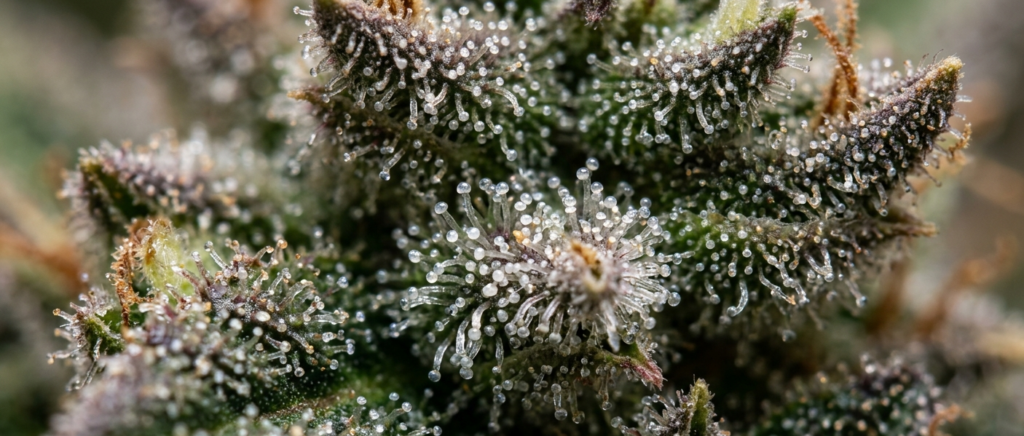
Hold a jar of good flower up to the light and tip it. The buds catch the light and throw it back, like the whole thing was rolled in sugar or dusted with frost. That sparkle is the first thing most people notice, and it is usually what they mean when they call a strain frosty. What they are looking at is a forest of tiny glands called trichomes, and almost everything you care about in cannabis lives inside them.
Cannabinoids like THC and CBD form there. So do the terpenes that decide whether a strain smells like diesel, lemon peel, or fresh-cut grass. The potency, the flavor, the way a particular cut hits you on a Tuesday night, all of it traces back to these structures you can barely see. We have written before about cannabinoids, terpenes, and the endocannabinoid system. This is the piece that sits underneath all of them, because trichomes are where those compounds are built and kept.
Once you understand what trichomes are and why the plant grows them, a lot of cannabis stops being mysterious. You start reading a jar the way a grower reads a plant, and you start to get why some products feel worlds apart even when the THC number on the label looks similar.
What Is a Trichome?
The word trichome comes from the Greek tríchōma, meaning growth of hair. That name fits the broad family. Trichomes show up all over the plant kingdom, on everything from carnivorous sundews to the fuzz on a tomato stem, and they take all kinds of shapes. On cannabis, the ones worth knowing are the glandular type: little resin factories that look, under magnification, a lot like microscopic mushrooms. A stalk rises from the surface of the flower, and a round, bulb-shaped head sits on top, swollen with resin.
That resin is the product. Inside the head of the gland, the plant builds and stores a thick, oily mix of cannabinoids, terpenes, and other compounds. The frost you see on a well-grown bud is thousands of these heads packed together across the flower and the small sugar leaves around it. Run your fingers over sticky flower and the residue left behind on your skin is ruptured trichome resin. That stickiness is the whole point of the gland, and it is why careful handling matters so much later on.
It helps to picture the gland as a sealed pocket rather than a coating. The compounds are not smeared across the outside of the bud. They are produced by a layer of cells at the base of the gland head and secreted up into a cavity beneath the waxy outer skin, where they collect and stay protected. The flower is carrying its most valuable cargo in millions of tiny sealed containers.
Why the Plant Bothers: Trichomes as Armor
Here is the part that reframes everything. The plant did not evolve trichomes to get anyone high. It grew them to survive. The compounds we prize are, from the plant’s point of view, a defense system, and that origin story explains a surprising amount about how cannabis behaves.
Start with pests. The sticky resin gums up small insects that try to cross the flower, and the same bitter, strong-smelling compounds that give cannabis its character taste and smell terrible to anything looking for a meal. A bug that lands on a frosted bud finds itself wading through glue that tastes awful. Larger grazing animals get the same message from a distance through smell alone and tend to move on.
Then there is sunlight. Cannabis often grows in open, exposed places that take a beating from ultraviolet radiation, and UV light damages living tissue, including the DNA inside the plant’s reproductive parts. Trichomes act like a built-in sunscreen layer over the flower. Cannabis plants exposed to higher levels of UVB radiation produce elevated levels of THC, which points to a protective role, and the plant appears to concentrate these compounds around its flowers to shield the next generation of seeds from sun damage.
Trichomes pull weather duty too, buffering the flower against wind and helping moderate the harsh swings in temperature and humidity that an exposed plant deals with. So the sparkle that signals quality to a shopper is, in its original job, a suit of armor. The plant builds the richest armor around the part it most needs to protect, the flower, which is why flower is where the resin is densest and why trim and stems carry far less.
The short version worth keeping: trichomes are the plant’s defense glands, and the cannabinoids and terpenes inside them are defensive chemistry. Everything cannabis does for a person is a side effect of how the plant protects itself.
Not All Trichomes Are the Same
Cannabis grows a few different glandular trichomes, and they are not equal contributors. Three types come up most often, and they are sorted by size and by how much they produce.
Bulbous trichomes are the smallest, in the range of ten to fifteen microns, far too small to see without a microscope. For scale, a human hair is somewhere around seventy microns across, so these are a fraction of that width. They are scattered across the surface of the plant but contribute little to the resin you care about.
Capitate-sessile trichomes are the middle tier. They have a rounded head but sit close to the surface on a short stalk or none at all, and they produce more than bulbous trichomes but far less than the big ones. There is an interesting wrinkle here that newer research uncovered. Sessile trichomes on the plant’s leaves reliably have exactly eight secretory cells in the base of the head, while the large stalked glands on mature flowers have twelve to sixteen. Some glands that look sessile on young flowers turn out to be carrying more cells than a true sessile gland should, which means they do not fit the sessile label. They are an earlier stage of a stalked trichome still developing. In other words, the biggest producers grow up from smaller-looking precursors.
Capitate-stalked trichomes are the stars. They are the largest, big enough to see with the naked eye as that frosty coating, and they are the most prolific producers of cannabinoids and terpenes by a wide margin. They crowd onto mature flowers and the surrounding sugar leaves, and they carry bigger internal cell structures than their sessile counterparts, which is why they are the richest source of the compounds that form THC and CBD and the largest producers of terpenes. When someone says a bud is coated in trichomes, these are almost always the ones doing the visible work.
This is also why flower built for resin tends to look the way it does. Dense, frosty buds are dense with stalked trichomes, and that coverage is a reasonable first-glance signal of quality. It is not the whole story, since poorly stored flower can still look frosty while having lost potency, but a healthy frost is a fair place to start.
Inside the Factory: How the Resin Gets Made
The gland head is not a storage tank alone. It is an active little chemical plant. At the base of each head sits a disk of secretory cells, and those cells are where the building happens. They pull in raw material from the rest of the plant and run it through a series of steps, and the finished compounds get pushed up into the cavity under the gland’s waxy skin, where they pool and wait.
The path a cannabinoid molecule takes is strange. Construction begins inside the cell, shifts into a different cellular compartment partway through, and finishes with a final chemical step out in the space outside the cell. The start and the end of this route are mapped, but how the molecule gets shuttled between stages is still not fully worked out. It is a reminder that even the best-studied plant in this category still has open questions in its basic biology.
There is a clever bit of self-defense built into all this. The acidic forms of these compounds, including THCA, can be toxic to the plant’s own cells at high concentrations. By secreting them out of the cells and into that sealed outer cavity, the plant protects itself from the chemistry it is producing. The gland is doing double duty: making the defensive compounds and quarantining them from the living tissue that made them.
One detail here clears up a common point of confusion. Fresh flower does not contain much THC or CBD at all. It contains their acidic precursors, THCA and CBDA, which are the forms the trichome stores. Those convert into the THC and CBD people are after only when heat and light are applied, a reaction called decarboxylation. That is what a lighter, a vaporizer, or an oven does, and it is why raw flower will not do much if you eat it straight. The trichome holds the loaded, unfired version. Heat is what activates it.
Reading the Color: What Trichomes Tell a Grower
Because the resin matures on a schedule, trichomes double as a clock. A grower with a magnifier or a jeweler’s loupe reads harvest timing straight off the gland heads, watching their color shift through a predictable sequence, and that sequence carries straight through to what ends up in the jar.
Early on, the heads are clear and glassy. The plant is still building, the compounds have not peaked, and harvesting now would mean weaker, underdeveloped flower. As the plant matures, the heads turn cloudy and milky, and that milky stage generally lines up with peak cannabinoid production. Most growers chasing potency aim to cut at or near this window. Push further and the heads start turning amber. That amber shift signals that some THC is degrading into CBN, a compound associated with a heavier, more sedating feel, which is why flower harvested a little later often lands softer and more couch-bound.
None of this is a single fixed rule. Different growers chase different windows depending on the experience they want a strain to deliver, and a mix of cloudy and amber heads is a common target for balancing brightness against body. The point is that the same trichomes that store the resin also broadcast its readiness, in a color code anyone with a loupe can learn to read.
Why Concentrates Exist at All
Once you accept that nearly all the value sits in the trichome heads, concentrates stop seeming exotic and start seeming obvious. A concentrate is the trichomes separated from everything else. Strip away the leaf, the stem, and the plant fiber, keep the resin, and you have something far more potent and flavorful by volume than the flower it came from. Every method of making a concentrate is, at bottom, a different way of knocking those heads off the plant and collecting them.
The plainest example is sitting in your grinder right now. That fine, pale-gold powder that collects at the bottom is kief, which is nothing more than dried trichome heads that broke off the flower and fell through the screen. Collect enough of it and you have a usable concentrate that took no solvents and no special gear to make.
Scale that idea up and you get hash and rosin. Some methods use ice water, chilling the trichomes so they turn brittle and snap off when the plant is gently agitated, then filtering the resin-rich material out through mesh. Because trichomes are not water soluble, they survive the wash intact as long as they are handled gently, and the cleaner the separation, the higher the quality. Other methods use pressure and heat to squeeze the resin out directly. Solventless approaches like these are prized because they preserve the original terpene and cannabinoid profile of the trichome rather than altering it.
This is also where careful handling pays off or doesn’t. Trichomes are delicate, and once a head ruptures, the compounds inside start to degrade. Heat, light, oxygen, and rough handling all break them down, which is why the same advice keeps showing up: store flower in glass, keep it cool and dark, and handle it gently. The frost is fragile gold, and treating it that way is the difference between flower that holds up and flower that goes flat.
Trichomes on the Ivy Hall Menu
The fastest way to make all of this click is to put a few products next to each other and notice that they are different answers to one question: how do you get the trichome off the plant and into a form you like, while losing as little of the resin as possible. Here are four on our shelves, each from a different brand, that map onto the story above. Stock moves fast and our menu runs deeper than any short list, so treat these as a starting point and ask staff what else is in.
Aeriz Hashburger 3.5g: An indica-dominant hybrid crossing Han Solo Hashplant with Double Burger, with a sweet, spicy, lemony hash flavor backed by woody pine. Aeriz grows it aeroponically, with the roots suspended in air rather than soil, which is a clean way to bring out heavy resin. This is the one to study if you want to see stalked trichomes doing their thing, since the frost is dense enough to appreciate without a loupe. It shows the principle in the jar rather than on the page.
Good Tide Pineapple Solventless Hash Rosin Gummies 100mg 10pk: A sativa gummy made with solventless hash rosin, which is pressed from washed trichomes using no chemical solvents. That matters here because the rosin keeps the gland’s naturally occurring terpenes and minor cannabinoids closer to intact, and Good Tide leans on that, pairing the rosin with real tropical pineapple so the plant’s own aromatics come through alongside the fruit. It is a clear look at how a clean trichome extract carries flavor into an edible.
Cresco Cheese Storm Live Resin 1g Cart: A balanced hybrid bred from UK Cheese and Super Skunk, with a citrusy, cheesy aroma driven by its top terpenes, myrcene, limonene, and caryophyllene. Live resin is made from fresh-frozen plant material, which captures more of those aromatic compounds before they can degrade, so the terpene profile you taste in the cart tracks closely to what the trichomes held. It is a clean example of how protecting trichome integrity shows up as flavor in a vape.
Kanha Cherry Limeade Live Rosin Belts 100mg 4pk: A sativa belt-style gummy with a punchy cherry-limeade flavor, made with solventless live rosin pressed from trichomes rather than extracted with chemicals. It sits at the candy end of the solventless spectrum, where the goal is to carry the trichome’s natural profile into the edible as faithfully as possible. A good counterpart to the Good Tide gummy for tasting how solventless extraction reads in a sweeter format.
Frequently Asked Questions
What are trichomes on cannabis?
Trichomes are tiny glandular structures on cannabis flowers and sugar leaves that produce and store cannabinoids and terpenes. They look like microscopic mushrooms, with a stalk and a resin-filled head, and they create the frosty, sparkling coating you see on quality flower.
Why does my weed look frosty or sparkly?
That frost is dense trichome coverage. Each gland head holds resin packed with cannabinoids and terpenes, and when thousands of them cover a bud, they catch light and look like sugar or crystal. Heavy frost is a reasonable first sign of resin-rich flower, though storage and handling also affect how potent that flower is.
Do trichomes determine how strong cannabis is?
Largely, yes. Trichomes are where THC, CBD, and other cannabinoids are made and kept, so denser, healthier trichome coverage usually means more of those compounds. Quality matters too, since old or poorly stored flower can still look frosty while the resin inside has degraded.
What is the difference between the three trichome types?
Bulbous trichomes are the smallest and contribute little resin. Capitate-sessile trichomes are mid-sized and produce a moderate amount. Capitate-stalked trichomes are the largest, are visible to the naked eye, and produce the bulk of the cannabinoids and terpenes. The stalked glands are what people usually mean by frost.
What do clear, cloudy, and amber trichomes mean?
The colors track maturity. Clear heads mean the flower is still developing and has not peaked. Cloudy or milky heads generally signal peak cannabinoid levels and are a common harvest point. Amber heads mean some THC has begun converting to CBN, which is linked to a more sedating effect.
How are trichomes related to concentrates like hash and rosin?
Concentrates are trichomes separated from the rest of the plant. Kief is loose trichome heads collected from a grinder. Hash and rosin use methods like ice water or pressure and heat to strip the resin glands away and concentrate them, which is why concentrates are far more potent by volume than flower.
What is kief?
Kief is the fine, pale powder that collects at the bottom of a grinder. It is made of dried trichome heads that broke off the flower and fell through the screen. It is the simplest concentrate there is, since it forms on its own with no solvents or special equipment.
Why does fresh flower need to be heated to feel its effects?
Fresh flower mostly contains acidic precursors like THCA rather than THC itself. Heat and light convert these into the active forms through a reaction called decarboxylation. That conversion is why smoking, vaporizing, or baking activates cannabis while eating raw flower does little.
How should I store flower to protect the trichomes?
Keep it in an airtight glass container, away from heat, light, and excess air, in a cool dark spot. Trichomes are fragile, and heat, light, oxygen, and rough handling all degrade the resin inside. Gentle handling preserves both potency and flavor.
Are trichomes only found on cannabis?
No. Trichomes appear across the plant kingdom in many shapes, from the sticky glands of carnivorous plants to the fuzz on tomato stems. Cannabis stands out because its glandular trichomes produce such high concentrations of cannabinoids and terpenes, which is what makes them so valuable.
What to Look for Next Time You Shop
Now that you know where the good stuff lives, a jar of flower reads differently. The frost is no longer decoration. It is the visible edge of the plant’s chemistry, the part you can see of a system the plant built to defend itself long before anyone thought to smoke it.
Put that to work. Hold the jar to the light and look at how dense and even the coating is, knowing those are mostly stalked trichomes and that heavier coverage points toward a resin-rich cut. Remember that a frosty look is a starting signal and not a guarantee, since storage and handling decide whether that resin is still in good shape. And when you reach for a concentrate, think about what you now know: each one is a different way of getting those gland heads off the plant while keeping as much of the resin as possible.
If you want a hand connecting any of this to what is on the shelf, that is what our budtenders are for. Ask which flower is showing the heaviest frost right now, or which solventless option holds onto the most flavor. Mapped onto where the good stuff lives, the answers will get you closer to the experience you are after.