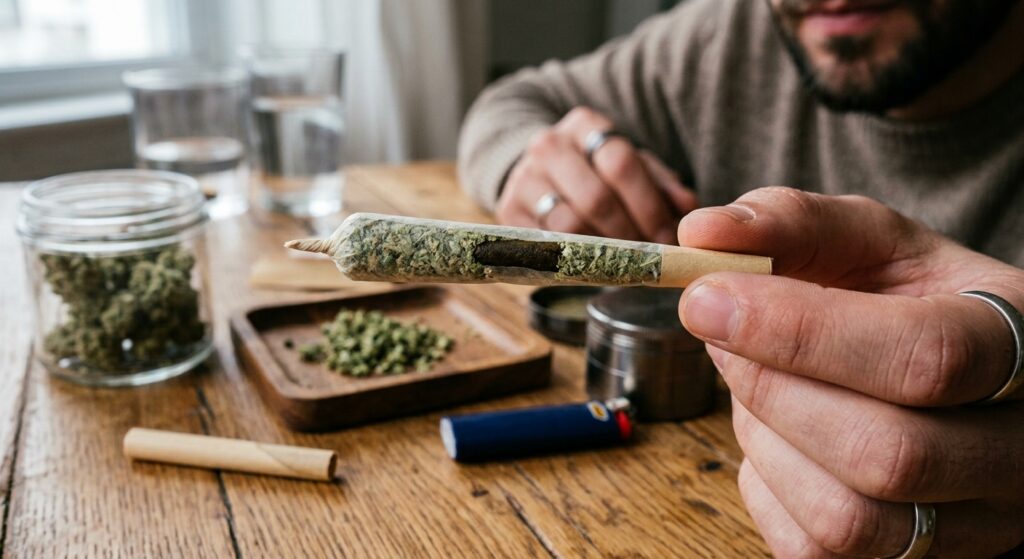
A hash hole is an infused pre-roll with a continuous line of concentrated hash running through its center, wrapped in ground flower on every side. The line goes by a few names on the production floor: a snake, a worm, a rod. The finished joint goes by a few names too, and donut joint is the one you will see most often on a menu.
That center core is the entire difference. Everything else about a hash hole looks like a pre-roll you already know.
The Core Is the Whole Point
Build one in your head and the format makes sense right away. A maker rolls solventless concentrate into an even snake, lays it down the middle of a bed of ground flower, covers it so no concentrate touches the paper, then rolls the whole thing closed with steady pressure from end to end.
The concentrate runs nearly the full length, from the tip down toward the filter. Thickness stays consistent, because a thick spot melts at a different rate than a thin one and the burn goes crooked. Most hash holes use a solid tip made of glass or wood rather than a rolled paper crutch, since paper soaks up oil and collapses once resin starts to travel.
Hash holes run larger than a standard 1g pre-roll because the core needs a real jacket of flower around it. The IC Collective Pheno Hunt #91 x I.C.K.O Infused 1.8g Hash Hole Pre-Roll shows the proportions at work: 1.5g of flower hand rolled around 0.3g of hash rosin, sealed in a glass tube so the roll does not get crushed and the core does not dry out on the shelf. Pheno Hunt #91 is the flower on the outside, I.C.K.O rosin runs down the middle.
Why the Ash Forms a Ring
Here is the mechanical part, and it explains the name.
Flame never reaches the core directly. The outer flower lights and burns inward, and the heat coming off that burning ring melts and vaporizes the concentrate from the side rather than from the front. Flower and concentrate consume at different rates. The flower goes first, the center lags behind, and what you see at the lit end is a ring of ash with an opening down the middle. Cut a spent one in half and the tunnel is visible the whole way back.
Radiant heat instead of direct flame is also why the flavor reads the way it does. Terpenes are volatile compounds and they come off cleanly at lower temperatures, so a core warmed from the outside in delivers more of them to the draw than concentrate sitting in an open flame.
The density of that center does something else worth knowing. It acts as a heat sink, which slows the whole joint down and evens the burn out compared to loose flower in a paper.
What the Core Buys You
Flavor and burn rate are the mechanical payoffs. The rest of the case is simpler.
Concentrate is far more cannabinoid dense than flower, gram for gram, so a joint carrying both lands harder than the same weight of flower on its own. That is the whole reason the format exists. Batch numbers move, so read the current panel on the menu rather than assuming one roll matches the last.
The other reason is access. Rosin is normally something you dab, which means owning a glass rig and a torch and learning to run them. A hash hole puts the same material inside a joint. You light it and smoke it, so it is the easiest way to try solventless concentrate if you have never bought any gear.
Size does work too. A roll in the 1.8g to 2.5g range burns long enough to pass around, and it arrives already built, so nothing about it depends on your rolling.
Where Hash Holes Sit in the Infused Pre-Roll Aisle
Every hash hole is an infused pre-roll. The reverse does not hold, and the distinction is worth carrying to the counter with you.
Infused pre-roll is a category name covering several construction methods. Concentrate can be blended through the flower before filling, painted on the outside of the paper, rolled in kief, which is the loose trichome powder that falls off flower, or dosed with diamonds, which are crystallized THCa. The IC Collective Quickies Chemfruit x T.I.T.S Hash Infused 2.5g 5pk Pre-Roll shows the difference, and comes from the same producer. Five half gram joints, Chemfruit flower infused with T.I.T.S bubble hash, and the hash goes in with the flower rather than sitting as a core. Same two ingredients as a hash hole, different geometry, no ring in the ash.
Rythm Remix Strawberry Sour Diesel Diamond Infused 2.5g 5pk Pre-Roll takes a third route. Indoor flower double infused with THCa diamonds and kief, tuned with natural terpenes, strawberry over pine and pepper. Potent and portable, and still not a hash hole, because nothing runs down the middle.
That geometry is the definition. The concentrate in a hash hole is a single positioned core, not a coating and not a blend, and the placement is what produces the staged burn and the donut. Set the two builds side by side and the pack of minis is the one for a short session, while the hash hole is the one asking you to slow down and rotate it.
What Solventless Means on a Hash Hole Label
Rosin cores are the tradition here, and rosin is a solventless extract. Heat and pressure squeeze resin out of flower or hash, and nothing else goes into the process. Ice water hash gets there another way, using cold water and gentle agitation to knock the resin heads loose before they are dried and pressed. Live rosin starts from fresh frozen material rather than dried and cured flower.
None of those involve butane or propane. That matters for a format built on flavor, because the point of the core is the resin’s own aroma coming through the smoke.
If you want to handle the material itself, IC Collective I.C.K.O. Live Rosin 1g is the same extract that runs through the Pheno Hunt hash hole, sold by the gram and pressed by a craft grow in Cary, Illinois. Warm a piece between your fingers and you can feel why it rolls into a snake so readily.
How to Light One Without Wasting the Rosin
Torching a hash hole is the fastest way to ruin one. The advice from people who roll them for a living is closer to cigar habits than cigarette habits.
Hold it horizontal and rotate it slowly while you apply flame, and take your time building an even coal across the whole face before the first pull. A hemp wick gives finer control than a lighter held sideways. Once the end glows, pull gently. Hard inhales pull the burn ahead of the melt.
If one side starts running ahead, tap that side lightly to knock the coal back, or touch a damp fingertip to the fast edge to slow it. Keep rotating as you go so the softened core stays centered instead of sagging to one wall. Set it down between pulls. A 2.5g hash hole holds more than twice the material of a standard 1g pre-roll, so there is no reason to rush through it.
Hash Holes Worth Knowing
Redemption Botanicals Konnichiwa Hash Hole 2.5g Pre-Roll Infused with Solventless Live Rosin is the full size version of the format. Konnichiwa is a hybrid, the core is solventless live rosin, and at 2.5g this is a roll to share or to put back in the tube halfway. Beta caryophyllene leads its terpene profile, with linalool and limonene behind it, so the pepper and the florals arrive before the citrus does.
Strain pairings rotate with whatever comes off the press, so the names on a hash hole change faster than the format does. The menu at your store lists what is available to order.
Frequently Asked Questions
What is a hash hole pre-roll made of?
Three parts. Ground flower, a core of solventless concentrate, and a paper with a solid tip holding it together. Ratios shift by producer, and the tip material is a bigger deal than most shoppers expect, since glass and wood handle resin without collapsing.
Why is a hash hole called a donut joint?
Look straight down at the lit end and the answer is right there. Ring of burning flower, opening in the middle where the core has melted back. Donut hole, wormhole, snake hole and rosin donut all describe the same thing, and which one you hear depends mostly on who rolled it.
Are all infused pre-rolls hash holes?
No. Kief coated, distillate painted and diamond infused pre-rolls are all infused, and none of them are hash holes, because the concentrate is not sitting as a core in the center.
Can a hash hole be relit if it goes out?
It can. Tap off the loose ash first, then re-toast the whole face the same way you lit it the first time instead of stabbing at one spot. A joint that keeps going out is usually packed tight or was lit unevenly at the start.
What is the difference between a hash rosin core and a bubble hash core?
Both are solventless and both come from the same starting material. Bubble hash is resin separated with ice water and agitation, then dried. Hash rosin is that resin taken one step further under heat and pressure into a smooth, pliable consistency. A rosin core is easier to roll into an even snake, which is part of why it dominates the format.
How should a hash hole be stored before I smoke it?
Leave it in the tube it came in, somewhere cool and out of the light. Warmth softens the core, and a softened core will settle toward one side of the joint if it sits on its side for long. Standing the tube upright is a small habit that pays off.
How to Pick Your First Hash Hole
Start with size. A 1.8g roll with a 0.3g core is a manageable introduction to the format and works fine on its own; a 2.5g roll is built for a group or for two or three sessions with a good storage tube. Then look at the core. Solventless live rosin and ice water hash are the classic fillings and the ones that carry the most flavor.
Expect it to hit harder than the pre-roll you usually buy, because you are smoking flower and concentrate at the same time. If that is new territory, take a few pulls, put it out, and come back to it. The tube it ships in exists for exactly that.
Expect to pay more too. The core is the expensive part, and a hash hole holds a meaningful amount of concentrate on top of the flower.
After that, treat it like buying flower. Read the strain pairing, ask what the rosin was pressed from, and check the current lab numbers on the menu at your store, since those move batch to batch.
A budtender can pull the case and walk you through which rolls are available and which core came off which press.