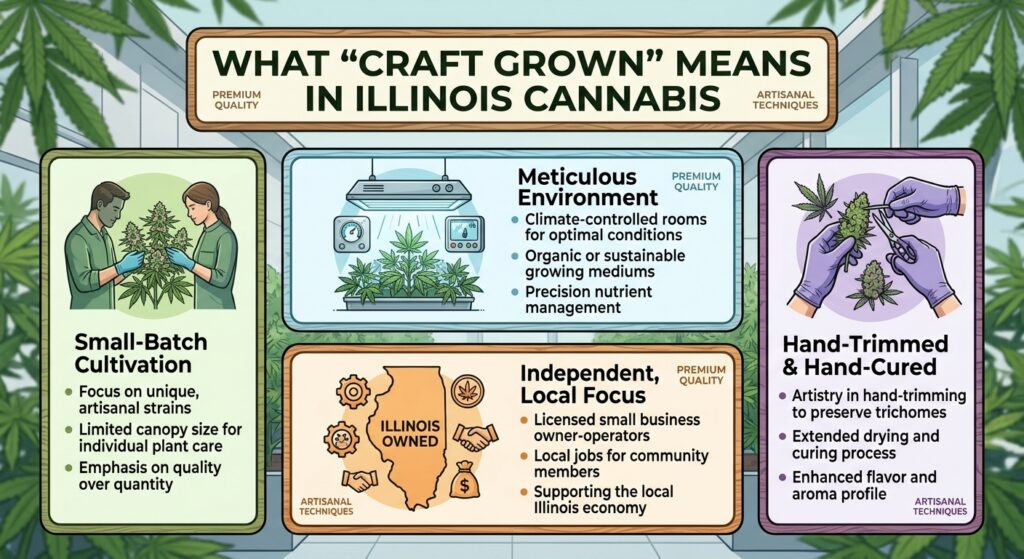
Craft grow is a license category in Illinois, created by the state’s adult-use law, and it comes with a ceiling on how much cannabis a grower may have flowering at one time. No federal standard defines “craft grown,” since cannabis is regulated state by state. In Illinois the phrase lines up with a specific license.
A craft grow license is the state’s cultivation license for small-scale growers. A craft grower may cultivate, process its own harvest into concentrates and infused products, and sell wholesale to dispensaries, cultivation centers, and infusers, though never directly to the public, which is why shoppers see craft growers as brand names on a shelf. The line separating a craft grower from a cultivation center is a hard cap on flowering canopy, and that cap drives nearly everything else about how craft cannabis gets grown.
The Canopy Cap Is the Whole Story
Illinois craft growers may have up to 14,000 square feet of flowering canopy, under the Cannabis Regulation and Tax Act. That figure replaced an older arrangement in which a grower started at 5,000 square feet and had to apply to the Illinois Department of Agriculture for expansions in 3,000 square foot steps. Senate Bill 3222, signed in June 2026 as Public Act 104-0463, set the single 14,000 square foot cap instead, and the Department is now repealing the canopy modification rules that conflict with it. The cultivation centers that held the market before 2020 were never held to that ceiling.
A craft grower therefore has a fixed amount of floor and an unfixed amount of attention. When the room cannot get bigger, the lever that stays available is what comes out of it, which tends to point the work toward genetics, selection, harvest timing, and the weeks after the chop rather than toward more square footage.
That shows up in the plant work. IC Collective Runaway Diesel, a cross of Oneway and Sour Diesel, came out of a hunt in which the grower culled through six phenotypes of the same cross before keeping one. Six expressions of a single cultivar is a serious way to spend a capped room, and the keeper has to be good enough to justify the five that got cut.
Craft Growers Often Spend Labor Where Scale Growers Spend Square Footage
Hash shows the trade most plainly. Redemption Botanicals Blueberry Lobster #4 Hash Hole is a hash hole, a pre-roll built around a core of solventless live rosin pressed from ice water hash with no solvent at any step. Fresh frozen material, cold water, agitation, sieving, a careful dry, then a press. Every one of those steps costs time and hands, which is part of why solventless extracts carry the prices they do. Redemption Botanicals holds a craft grow license and runs out of Tilton, and building a product this labor-heavy fits a capped room better than a large one.
Curing follows the same logic. Terpenes are volatile, and the working assumption among growers is that a slow dry in controlled conditions preserves more of them than a fast one does. How much of that character reaches the jar varies with the cultivar, the batch, and the room it was dried in.
Social Equity Was the Reason the Category Exists
Lawmakers did not create the craft license to improve flavor. They created it to open a door into an industry that, before the adult-use law, ran entirely through large cultivation centers dominated by multistate operators. Craft became the entry point for Illinois residents, and the application scoring was written so that social equity status carried real weight.
That intent is written into the scoring itself. Under the Act, social equity applicant status has to account for at least 20% of the total points available on a craft grower application, alongside points for Illinois residency and for economic empowerment in disproportionately impacted areas.
Flora Arbor Where’s My Bike is one of those licenses sitting on a shelf. Flora Arbor was awarded its craft grow license as a social equity applicant and cultivates in Elgin for several brands alongside its own. Its flower runs terpinolene forward with ocimene second on the panel.
Holding a license and opening the doors are separate problems. Capital, zoning, and buildout stand between the two, and plenty of licensees have not cleared them, which is why craft brands make up a small part of any Illinois menu, our own included.
A Capped Canopy Is Also a Calendar
Short runs are often a consequence of the license rather than a sales tactic. Everything flowering in a craft room occupies space that cannot be added to, so a grower runs a cultivar for a cycle and then hands the room to the next one. That is why a craft cultivar can be absent for months and then reappear, and why a craft grower’s catalog can turn over in a way a large cultivator’s core lineup usually does not.
The cap also changes what gets optimized at harvest. Cutting a week later for ripeness costs a week of a room that is already small, and some of the growers who take that trade turn out lab panels where the terpene total is the interesting line and the THC total is ordinary. Both halves of that show up inside a single craft lineup. Nez MAC Stomper leads on limonene with caryophyllene, ocimene, and pinene behind it, while its stablemate Blueberry Sugar reads lower on THC and higher on total terpenes than much of the flower sitting around it. Nez is family owned and single source, which means the same hands carried the plant from clone to jar.
Genetics face the same pressure. A cross can hold its place in a capped room on aroma and flavor as much as on yield, because the space it occupies has to be taken from something else. Kaviar Black Cherry Cookies crosses Black Cherry Pie with Girl Scout Cookies, a dessert-leaning selection of exactly the kind that survives that test.
Results move from batch to batch as well, since every harvest is tested on its own. A certificate of analysis describes the lot in the jar rather than the cultivar in general.
Frequently Asked Questions
Does a craft grow license require organic or living soil cultivation?
Nothing in the license dictates a growing medium. Illinois caps canopy and sets efficiency standards for lighting and HVAC, and leaves the rest to the cultivator. Living soil, coco, hydro, and everything between them are all legal inside a craft room, which is part of why two craft growers can turn out flower with almost nothing in common. Soil questions go to the brand, not to the license.
Can I buy directly from an Illinois craft grower?
No craft grower in the state sells to the public. The license allows wholesale to licensed dispensaries, cultivation centers, and infusers, so a dispensary counter is the only place a craft grower’s work reaches a shopper. It also means the brand on the package and the business holding the license are sometimes two different companies.
How do I tell who actually grew the cannabis when a brand is named after a celebrity?
Picture a package with a famous name on the front. That name is a brand license, and somewhere in Illinois a cultivator with a state license is growing those genetics under contract. Several well known national brands reach Illinois shelves this way, grown by craft licensees here rather than shipped in, since cannabis cannot cross state lines. The cultivator is the one who grew it, so that is the name worth asking about at the counter.
Why does a craft cultivar vanish for months and then come back?
The room is capped, so the calendar is a queue. Whatever is flowering now is not flowering next month.
Is craft flower stronger than flower from a large cultivation center?
Not as a rule, and that is the wrong frame for it. Plenty of craft growers run their rooms for aroma, flavor, and ripeness, and a jar from one of those rooms can read mid-range on THC and high on terpenes next to the shelf around it. Some craft lots do test near the top of the menu, and plenty of flower from large cultivation centers is grown for aroma too. Where a difference does show up, it tends to be in how the flower smells when the jar opens and how it tastes on the back half of a bowl rather than in the headline number, and it varies by grower and by batch.
Do craft growers hand trim?
Some do, and a capped room is what makes the choice workable, since hand trimming costs time that scales badly as canopy grows. Hand trimmed is a practice rather than a license requirement, though, so it holds for some craft lots and not others. The package or the brand will tell you; the license will not.
What Changes for Illinois Craft Growers Next
Two further shifts are worth watching. The same law, Senate Bill 3222, put a two-year moratorium on craft grower and infuser licensing fees, which lowers the carrying cost for operators who are built but not yet profitable. It also lets any Illinois dispensary opt into medical sales as of September 10, 2026, which is how craft grown products reach registered patients at stores like ours, medical cannabis at Ivy Hall included, rather than only at the dispensaries that held a dual-purpose license under the older rules.
Both changes point the same direction: more craft operators reaching harvest, and more of what they grow reaching registered patients. The craft category has always depended more on policy than on horticulture, which is why the next few legislative sessions will say more about how much craft grown flower exists in Illinois than any grower will.