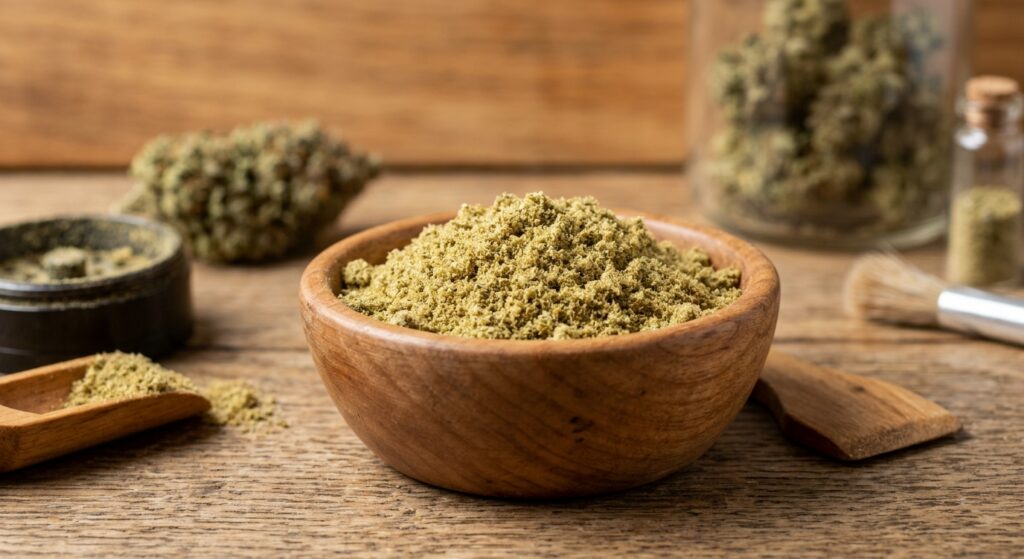
Unscrew the bottom chamber of a three-piece grinder after a few weeks of regular use and you will find a small drift of pale powder sitting in it. That powder is kief, and it is the most concentrated material in the grinder. Anyone who grinds their own flower is already collecting it, whether or not they meant to.
What Kief Is, and Where It Comes From
Trichomes are the reason kief exists. They are the resin glands that coat mature cannabis flower and the sugar leaves around it, and they produce and store the plant’s cannabinoids and terpenes. Under magnification each one looks like a tiny mushroom with a bulbous head on a stalk. The heads run clear while the plant is still filling in, turn cloudy as it matures, then shade toward amber.
Those glands are fragile once the flower is dried and cured. Handling knocks them loose. Grinding knocks loose a lot of them. What comes off is kief: a loose, powdery pile of broken gland heads, somewhere between blonde and brown depending on how clean the separation was.
You will see it under other names. Some menus and older growing books call it dry sift or pollen, and it shows up spelled keef now and then. The word itself comes from the Arabic kayf, meaning pleasure or well being.
Why Kief Is Stronger Than the Flower It Came From
Ground flower is mostly plant material. Fiber, chlorophyll, bits of stem, and the gland heads scattered across the surface. Kief is the gland heads with most of the plant left behind, which is why a pinch of it does the work of a considerably larger pinch of bud.
Published potency figures for kief vary from one source to the next, and they vary from batch to batch anyway, so the number worth reading is the lab panel on whatever you have in hand, which every concentrate and pre-roll listing on the Ivy Hall menu prints in full. The practical version is simpler. Start with an amount around the size of a grain of rice and work up from there once you know how it treats you.
How to Collect Kief in Your Grinder
A grinder with a kief catcher does the sorting for you. Four-piece grinders, and the five-piece versions above them, have a fine mesh screen under the flower chamber and a shallow catcher below it. As the teeth break up the bud, loose trichome heads fall through the screen and settle in the catcher, while the ground flower stays up top where you can get at it.
Grind slowly. A fast, hard twist shreds the flower without giving the powder time to drop, and the heads end up smeared into the plant material instead of falling through.
Two-piece grinders have nowhere for any of this to go, and a three-piece normally adds a storage chamber rather than a screened catcher, so the powder stays mixed in with the flower. In a two-piece the trichomes come off the bud the same way, then stick to the walls, the teeth and the threads, which is where most of a lifetime’s worth of kief quietly goes to die.
Moving up a tier is one of the cheaper upgrades on our accessories shelf. The Ivy Hall 62mm 4pc Grinder with See Through Bottom is the version to pick up if kief is the goal, because the piece count is the whole specification: lid, grinding chamber, flower chamber, and the catcher sitting under the screen. The clear bottom earns its place here too. You can see how much has gathered without unscrewing the stack to check, which matters when the answer for the first several weeks is “not yet.” Size, material and tooth pattern all change how a grinder handles flower, and our guide to picking the right grinder for your flower works through those choices in detail.
Patience is the other half of it. Kief accumulates in grains, not scoops, and weeks or months of ordinary grinding sit behind a pile big enough to do anything with. Many grinders ship with a small scraper for getting it out of the corners of the catcher.
The Coin Trick and the Kief Box
A grinder coin pulls more kief out of the same flower. It is a clean, dry, smooth-edged coin dropped into the chamber that sits above the kief screen. When you shake the grinder, the coin rattles around and knocks loose the gland heads wedged in the mesh, which otherwise stay there. Sanitize it before it goes anywhere near your flower.
A kief box works the other direction, starting with the flower rather than catching what falls off it. It is a shallow box with a mesh screen partway down and a collection compartment underneath. Flower goes on the screen, the lid goes on, you shake it, and the trichomes sift through. It handles much more material at once than a grinder does.
Screens on their own work too, and this is where the numbers get interesting. Trichome heads measure roughly 20 to 120 microns across. Sifting screens are rated the same way, and something in the 75 to 125 micron range is a reasonable target for kief. Home sifters often stack several screens from coarse on top to fine underneath, so the larger plant debris gets caught high and only the gland heads make it to the bottom. That stacking is the whole difference between pale, clean kief and a greenish powder that smokes rough.
Reading the Color of Your Kief
Color tells you how much plant material came through with the gland heads. Blonde, light tan and off-white kief is mostly resin. Green or dark powder has leaf and stem dust mixed in, which dilutes it and makes it harsher when it burns.
Pressing changes the color too, and in the other direction. The more heat and pressure kief sees, the darker it gets, which is why hash is brown and loose kief is pale.
What to Do With Kief Once You Have a Pile of It
Crown a Bowl
Packing a bowl and sprinkling a pinch of kief over the top is the shortest route from catcher to session. Spread it across the surface rather than dropping it in one spot, because the fine powder catches and burns faster than the bud underneath it. Then corner your hits: hold the flame to one quadrant of the bowl at a time instead of torching the whole surface, and the kief lasts for several pulls instead of one.
Roll It Into a Joint, or Coat the Outside
Kief goes into a joint two ways. Mixed through the ground flower before you roll, where sandwiching it between layers of bud keeps it from trickling out the ends, or stuck to the outside of a finished joint, which is the move people call twaxing. Dampen the outer paper lightly and roll the top third through your kief.
Two of the infused pre-rolls we carry at Ivy Hall already come built that way. 93 Boyz Pineapple AK Rellos Infused with Kief is a 1.5g hemp blunt with a glass filter tip, infused with oil and then coated in kief, so it is the twax method done at production scale and with a tip that holds its shape to the end. It is a hybrid, and beta caryophyllene and terpinolene lead its terpene profile, which puts a peppery edge under the tropical pineapple side of the strain.
If a whole blunt is more than you want to commit to in one sitting, Swift Lifts Short Lifts Rotten Teeth x Gelato Infused & Kief Coated splits the same idea across five half-gram pre-rolls in a 2.5g pack. Same infused and kief-coated construction, indica side of the shelf, five separate occasions.
Press It Into Hash
Hash is kief that has been compressed, and you can make it with what is in your bathroom drawer. Fold the kief into parchment paper, then apply heat and pressure with a flat iron or a pollen press. The heat and pressure rupture the gland heads and change the texture from loose powder to a pliable, darker mass. Rolled into balls by hand it is called a temple ball. Charas is a separate tradition rather than another name for the same thing, since it is resin rubbed by hand off a living plant instead of sifted from dried flower. Pushed further between hot plates, the resin itself starts to run, and what you collect is rosin.
Commercial presses take this much further than a flat iron can, and the textures that come out the other side have names of their own. Our concentrate texture guide to diamonds, sauce and badder sorts out which is which. Hash turns up rolled into pre-rolls too, most visibly in the hash hole, the donut joint built around a core of hash.
Build a Moon Rock
A moon rock is a nug coated in a sticky concentrate and then rolled through kief, which is the layered version of everything above. Warm the concentrate slightly so it spreads, coat the bud, roll it in kief, and let it set. Break it apart by hand when you smoke it, since a grinder will smear the coating instead of cutting it.
Ivy Hall carries a version that arrives already assembled. Kaviar Pineapple Donutz Moon Rocks is a 1g sativa built as a blend of flower, hash oil and kief, which is the moon rock recipe in three named parts rather than a mystery coating. The aroma runs tropical pineapple into sweet pastry and sugary dough, and it is the one to reach for if you want to see what the kief layer adds before you commit a month of grinder savings to making your own.
Cook With It
Kief has to be decarboxylated before it goes into food. That means low, slow oven heat to activate the cannabinoids first, and then folding it into a fat such as butter or oil so it distributes through the batch. Published times and temperatures differ, so follow whichever recipe you are working from rather than splitting the difference. The part worth remembering is the ratio: kief is concentrated, so a batch needs far less of it than it would need of ground flower, and eyeballing it is how people end up with brownies they regret.
Dabbing Kief and Rolling It Straight: Two Jobs It Is Not Built For
Dabbing kief is the first thing to skip. Kief still carries a little residual plant material, and plant material scorches on a hot nail instead of vaporizing, which tastes bad and leaves a mess in the rig. Press it into hash first if dabbing is the goal.
A joint of pure kief is the other one. With no plant material to slow it down, kief burns fast and unevenly, so the thing races away and smokes harsh before you get the benefit of what you packed into it. Kief wants flower around it.
How to Store Kief So It Keeps
Air, light, heat and moisture are what degrade kief, and all four are easy to shut out. An airtight glass jar in a cool, dark cabinet covers most of it. Make sure the container is dry before the kief goes in, because moisture invites mold and ruins the texture.
Handle it with a small scoop or a brush rather than your fingers, since skin oils pick up the powder and degrade what is left. Label the jar with the strain, if you know it, and the date you collected it. Stored properly, kief holds its potency and aroma for months and often close to a year before it starts to fade.
Frequently Asked Questions
Can I buy loose kief at Ivy Hall?
It depends on the week. Loose kief and dry sift rotate on and off Illinois menus, and at the moment our Chicago area shelves lean toward kief that has already been put to work, meaning kief-coated pre-rolls and moon rocks rather than a jar of powder. A budtender can tell you what has landed recently.
Can I put kief in a dry herb vaporizer?
A dry herb vaporizer handles kief, and heating it rather than burning it is a cleaner way to taste the terpenes. Use a small amount, and check the mesh in your chamber first, since loose powder will sift straight through a coarse screen.
Will kief clog my grinder’s screen?
Resin builds up in the mesh over time, which is exactly why the coin trick exists. A coin riding above the screen shakes loose a good share of what the mesh is holding onto, and the gland heads it frees are ones that would otherwise never reach the catcher.
Does kief need to be ground before I use it?
No. It arrives as powder, which is the whole point of it.
Why is my kief clumping together?
Kief compacts as it sits, and a pile left alone in a catcher for a month will press itself into a disc. Stirring it every few days with a pick or a comb keeps the powder loose and scoopable.
How much flower does it take to collect a gram of kief?
There is no honest fixed answer, because trichome density varies by strain, freshness matters, screen size matters, and how roughly the flower was handled before it reached you matters. Dense, frosty, well-cured flower gives up noticeably more than dry, over-handled bud. Plan on weeks of grinding rather than a single ounce.
Kief, Hash and Dry Sift Are One Material at Three Stages
These three words get used interchangeably, and the distinction is worth having straight. Kief is the loose powder of separated gland heads. Hash is that same powder compressed under heat and pressure into a solid. Dry sift is another name for kief, used most often for screen-separated material collected at scale rather than the pinch in a home grinder.
Ice water hash sits off to the side of all three. It reaches the same gland heads by agitating flower in ice water and filtering the result, rather than by sifting dry material through a screen, which is why it looks and behaves differently from pressed kief. Both roads get there without solvents, and if that distinction is new to you, our piece on solventless versus solvent concentrates explains what changes hands between the two methods.
Knowing which of those words is on a label tells you what you are holding and roughly how it was made. It is the difference between buying the raw material, the pressed version, or the finished layered product, and all three start in the same place: a few thousand resin glands that fell off a flower.